
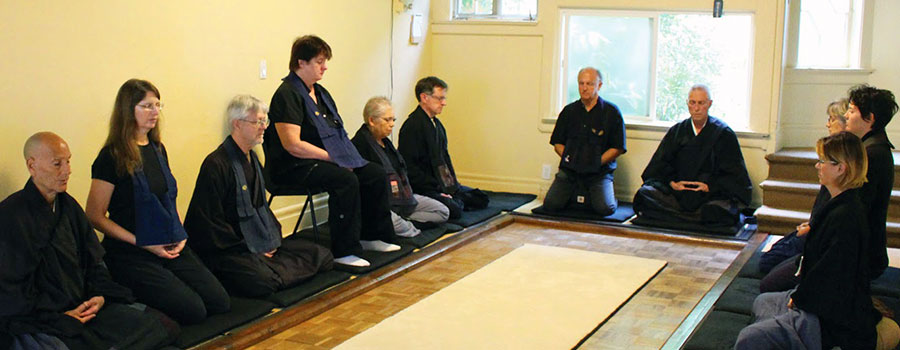
Zen Liturgy
Since pre-historic times, human beings have gathered and melded their voices together in chant. In some cases such chanting has carried specific meanings, prayers, and incantations. In other cases, ritualized sounds have had their own power. To this day, across religious traditions, chant is performed as an offering, as recitations of revealed truth, and as a way of affirming social bonds. Zen liturgy makes use of chant in all these forms, building on traditions established by the earliest Buddhist communities.
There are chants that accompany taking refugee in the Three Treasures, a chant that precedes a meal, and chants dedicated to the health and safety of our Temple and its practitioners and family members. Short chants, known by the Sanskrit word gatha, punctuate our day, especially our time in the Zendo. Liturgy services feature longer chants which are often scriptural excerpts. These writings have been singled out for daily or weekly recitation as they articulate realized wisdom as it has been passed down and reaffirmed generation after generation. Almost all of our liturgy services are in line with Soto Zen tradition and can be experienced at roughly the same times of day in Zen temples around the world, either in English, Japanese, or other local languages. Here in Los Angeles, we mostly chant in English with some elements in Japanese. Liturgy books are always available at all of our services.
Key elements in our liturgy services include the Heart Sutra, the Identity of Relative and Absolute, and Song of the Jewel Mirror Awareness. All of our liturgy can be found on the member section of this website (although this requires a password).
Below, we have provided a sample of some of the key gathas that are chanted daily at ZCLA. They were performed and recorded by Roshi Kipp Ryodo Hawley and Senior Student Elizabeth Jiei Cole.
Gatha of Atonement
This chant is done daily at the start of dawn zazen.
All karma ever committed by me since of old,
Due to my beginingless greed, hatred, lust, envy, and delusion,
Born of my actions, speech, and thought,
Now I atone for it all.
The Four Great Vows
This chant is done at the end of each day and most events.
Numberless beings, I vow to serve them.
Inexhaustible delusions, I vow to end them.
Boundless dharmas, I vow to practice them.
Unsurpassable Budddha Way, I vow to embody it.
The Verse of the Kesa
This chant takes place at the end of dawn zazen.
Vast is the robe of liberation,
A formless field of benefaction.
I wear the Tathagatha’s teaching,
Serving all sentient beings.
Gatha on Opening the Sutra
This chant is done before every dharma talk.
The Dharma, incomparably profound and infinitely subtle,
Is always encountered but rarely perceived
even in millions of ages.
Now we see it, hear it, receive and maintain it.
May we completely realize the Tathagatha’s true meaning.